
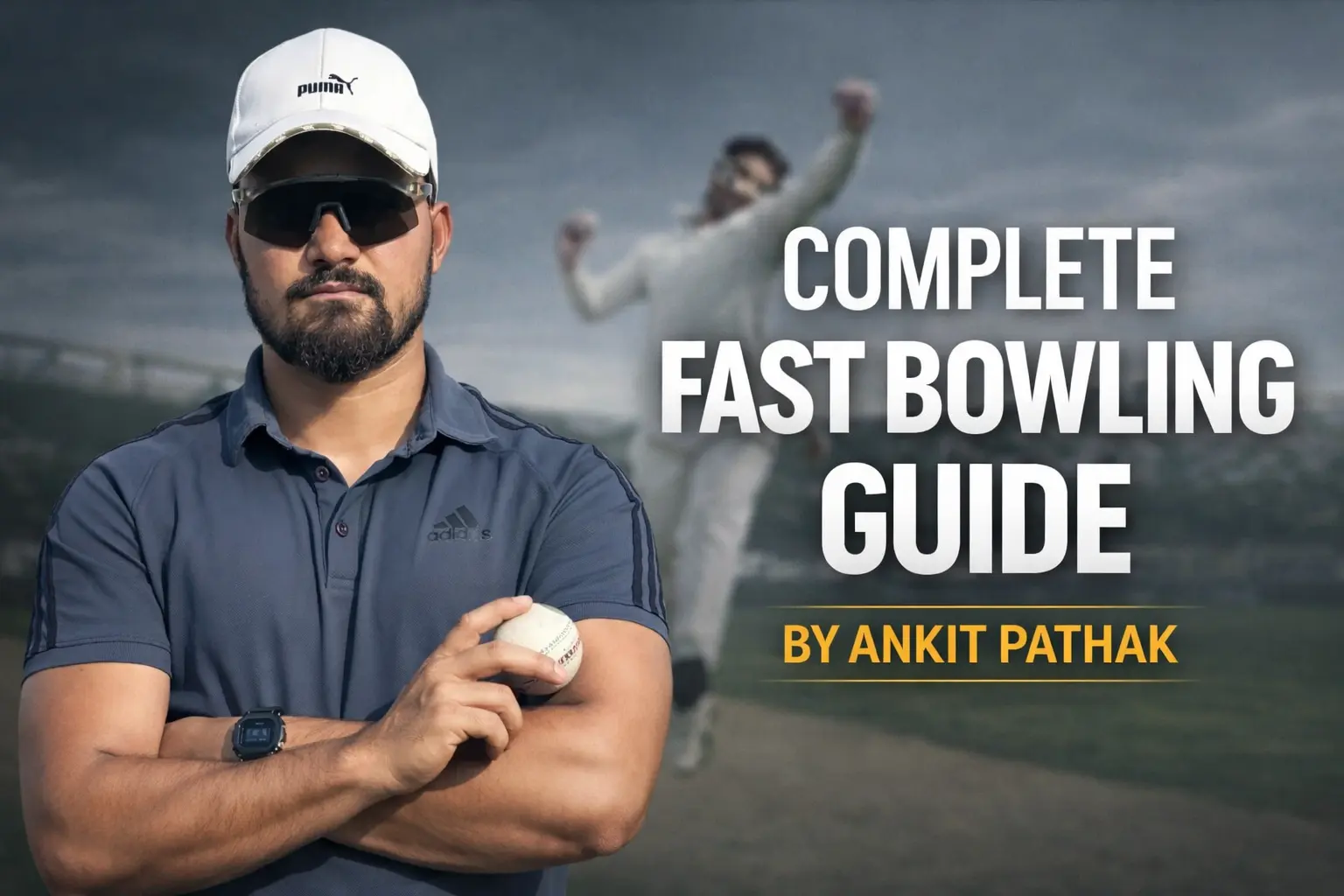
Fast bowling in cricket is a complex skill, young bowlers often struggle with inconsistent pace, accuracy, or injury risks due to flawed technique. This comprehensive guide by fast bowling coach, Ankit Pathak covers every part of the action, from run-up to follow-through, with practical tips and drills. By the end, you’ll know the safe, effective way to bowl fast, and what not to do.
Why Fast Bowling Technique Matters
Good fast bowling technique is essential for speed, consistency, and injury prevention. A balanced, repeatable action lets you deliver with power and accuracy. For example, research shows that bowlers who maximize run-up momentum and transfer it efficiently bowl faster. A weak front leg or slumped posture bleeds pace and can even cause back stress fractures. Conversely, a well-braced front leg and strong core help drive the ball. In short, flaws in your action waste energy, good technique amplifies your natural pace.
What Is the Correct Fast Bowling Action
The correct fast bowling action means a smooth sequence of movements that steadily transfer energy from your run-up into the ball. It starts with an aggressive but controlled run-up, leads through a powerful delivery stride, and finishes with a balanced follow-through. Key fundamentals include a high arm position, strong core and leg drive, and coordinated body alignment.
A correct action also respects the rules. We focus here on the mechanics: use your legs and trunk to build momentum, keep your bowling arm long and fast, and let your body finish facing the batsman. We’ll break this down step by step, but some overall pointers: Hold the ball with a proper seam grip and wrist to aid swing, keep your head and chest forward, and land your feet under your hips to stay balanced. Small details like these ensure you bowl efficiently and safely.
Step by Step Fast Bowling Technique
Below are the crucial phases of the fast bowling action. Each builds on the last, so missing a step often ruins pace and consistency. We’ll go through them in order: run-up, gather/jump, back foot contact, front foot landing, hip/shoulder turn, arm swing, and follow-through.
Run-Up Technique
Your run-up is about building momentum, not sprinting flat-out. Most top pacers run in at about 80–90% of top speed. Work on a balanced, rhythmic approach that lets you hit the crease in full flow. Mark your run-up distance so it’s consistent with each ball, alignment drills can help keep your path straight.
Keep your run-up relaxed; focus on rhythm rather than raw speed. Jerky or hesitant starts will disrupt your action. Many bowlers have a habit of rushing too fast, then nearly tripping on the crease. Instead, aim to build even speed: fast enough to generate force, but still under control. This way you reach the delivery stride ready to explode into the ball.
Gather and Jump
Just before you release the ball, you gather your energy in a bound or hop, think of it as the coiled spring phase. At the top of your run-up, start transferring momentum upward: raise your chest and swing your non-bowling arm up toward the sky. Your body should lift slightly so your bowling arm can drive down powerfully.
The gather throwdown phase looks like this: As your front foot lifts to stride in, both arms go high, and you bend slightly at the waist. This readies your shoulders and arms to rotate. Your chest should be falling forward toward the batsman. Don’t rush this, a controlled hop lets you time the release. After the hop, your back foot lands with the knee springy but not collapsing, keeping momentum running into the delivery.
Back Foot Contact (BFC)
When your back foot lands behind the popping crease, it’s a critical collision event. You want to transfer the run-up speed into your body with minimal loss. Don’t let your back knee collapse, think of it as a stiff spring. A bent knee acts like a shock absorber and wastes energy. Many coaches cue long shins or push off quickly here. Strengthening ankles and calves helps keep this step fast and powerful.
Ideally, the non-bowling leg should land roughly beside or slightly across your line of delivery. This keeps you upright and ready to rotate, rather than collapsing sideward. If you do collapse at BFC, you not only lose pace but also increase injury risk, studies link slack back-foot landings to lumbar stress fractures. After BFC, you should be leaning forward, chest over front thigh, ready to brace on the front leg.
Front Foot Landing (Front Foot Contact, FFC)
The moment your front foot plants is where power transfers up the chain. Aim to land on your heel, with that front knee picking up the load. Then brace the leg as you release the ball. A braced front leg acts like a wall that stops the lower-body momentum quickly. That abrupt stop sends all your forward energy into the ball.
Keep the knee firm, not wobbly. A knee collapsing under you at release = leaking power and a sore knee or back. If you brace too early or stiffly, you might “bounce” the ball; if too late, you lose rhythm. So practice drills like placing a cone where the front foot should land to groove a consistent spot.
Hip and Shoulder Separation
One of the most powerful, but misunderstood, parts of fast bowling is the shoulder-hip separation at the delivery stride. In simple terms, hips rotate toward the batsman faster than your shoulders. This twist generates extra power like winding up a spring.
At front foot contact, drop the non-bowling arm across your body, pulling against your bowling arm’s forward swing. This creates counter-rotation. For a split second, your hips are more open than your chest. Ideally, the hips might face the batsman much more than the shoulders. Think “chest stays back slightly so it can uncoil”.
The benefit? When your shoulders finally whip around to square, that stored energy releases into the ball. This chest drive can add pace without extra effort. However, it must be timed: too much separation too early is risky. Instead, let your front arm pull down at the right moment. We suggest delay pulling the front arm down until the bowling arm accelerates, maximizing energy transfer.
Arm Rotation and Full Arm Bowling
Now for the hands. Keep your bowling arm long and aim for a full extension at release. In fast bowling, a full arm action means your elbow stays high and nearly straight when you throw. This ensures maximum lever length for speed, while also preventing illegal chucking.
As you release the ball, whip the bowling arm down quickly. Snap your wrist through the bowling seam; think of flicking the seam to desired angle. A full arm allows a clean release and good bounce. If your elbow drops too early, you’ll be slower and give the umpires grief.
Also coordinate the non-bowling arm: as mentioned, it should have started high and swung down. At the point of release it can be across your chest or roughly at shoulder level.
Make sure your shoulders and hips square up briefly at release, then your bowling arm follows through diagonally down and out. Some coaches say the bowler’s finish with the arms should be pointing to or past mid-off or mid-on that means your release is long and complete.
Follow Through
A proper follow-through continues your momentum safely after the ball is gone. Don’t just stop when you let go, that sudden jerk can injure you. Instead, keep moving forward and running down the pitch 3–5 steps. This lets the rest of your momentum dissipate and prevents a hard landing. Drive your back knee through and aim your torso toward the batsman or mid-off; this helps maintain balance and alignment.
At the end of the follow-through, your head and chest should be upright and pointed toward the batsman or slip cordon. Avoid falling dramatically to one side.
Fast Bowling Drills to Improve Technique
Practicing the right drills is how technique becomes second nature. Here are some high-impact drills, used by coaches, that target key parts of the action:
- Target Cone Drill (Line & Length): Place cones or a target at a good length or yorker spot. Bowl aiming to hit them repeatedly. This builds control and simulates bowling to a plan under pressure.
- Run-Up Alignment Drill: Use markers along your run-up to keep it straight. Practice with a cricket stump or rope to ensure your final strides are in line. Better rhythm in the run-up leads to more consistent release and pace.
- Wall Arm Slam Drill: Stand a few meters from a wall and perform your bowling action throwing a tennis ball or light medicine ball into the wall. Focus on a quick arm and wrist flick. This drill isolates and speeds up your arm swing without the full run.
- Weighted Ball Bowling: Occasionally practice with a slightly heavier ball. This builds bowling-specific arm and shoulder strength. Be cautious, only use it once in a while, and never overdo it. When you switch back to a normal ball, you’ll feel your action is stronger and quicker.
- Back-Foot Landing Drill: Practice landing your back foot in the right spot every time by putting a cone where it should hit. Bowl full runs with focus on hitting that cone. This teaches balance and powerful ground contact.
- One-Stump Drill: Challenge yourself to hit just the top of the middle stump from full run-up. It’s harder than it sounds. Count how many of 10 deliveries are on target. This drill sharpens your focus and control under match pressure.
- Half Run-Up / Shadow Bowling: Use a shorter run-up and concentrate on your action: front arm, jump, and release mechanics. This isolates technique from full momentum. It’s especially useful if you’re correcting a flaw or returning from injury, as it forces you to feel each component of your action.
- Strength & Plyo Circuit: Incorporate cricket-specific strength and explosiveness exercises into your gym work. For example, squat jumps, lunges, medicine ball throws or slams, and core work. Strong legs and core mean more force into the delivery.
- Eyes-Closed Rhythm Drill: With supervision, try bowling with your eyes closed. This unusual drill forces you to feel your action’s timing and balance. It can reveal hidden inconsistencies and build a better internal sense of your delivery rhythm.
Embedding these drills into your practice builds muscle memory and power. As Ankit Pathak says, “Keep practicing with purpose. Trust the process. And unlock your true pace, one drill at a time.”
Bowling Action Correction Drills
If your action has bad habits, use slow, focused drills to fix them. For example:
- Mirror or Video Practice: Bowl in front of a mirror or record yourself on video. Watch your alignment, arm position, and knee angles. Adjust one thing at a time.
- Flat-Batting Side-Arm Drill: Bowling from a distance of just a few steps concentrating on just the arm circle and release. This is like a cricket throw, forcing you to focus on elbow position and straightening it fully.
- Resistance Band Knee Drill: Use a light resistance band around your knees and do your run-up; it can train you to keep legs aligned under hips, preventing collapse at contact.
- Back-to-Wall Wrist Drill: Stand with your back a few feet from a wall, perform your bowling arm action without stepping forward, just the arm circle. Ensure the ball stays above shoulder height until release. This encourages high elbow position.
Correction drills should be done gradually. Fixing an action overnight often breaks rhythm or causes other problems. Work on one aspect in drills, then slowly integrate it into your full bowling.
Common Fast Bowling Action Mistakes
Even good bowlers can slip into bad habits. Watch for these common errors:
- Front Knee Collapse: Letting the front leg buckle at landing. This not only bleeds pace but strains the knee/back.
- Rushed Run-Up: A jagged or overly long run-up can throw you off-balance. Young bowlers often sprint unevenly, then stumble on release. A smooth, controlled run-up is better.
- Dropping the Non-Bowling Arm Too Early or Late: If your left arm drops at the wrong time, you won’t get proper hip-shoulder separation. Some coaches tell bowlers “bring the left arm down slowly and deliberately” to avoid flailing.
- Low Bowling Shoulder: Bowling with a non-parallel shoulder line at release is inefficient. Keep shoulders aligned over the hips.
- Lateral (Side) Tilt: Too much bending sideways in your spine during delivery. This is unnatural and increases back injury risk. Ideally you rotate, but stay upright as much as possible.
- Looking Down: Many bowlers look at their front foot as it lands. This upsets alignment and reduces balance. Keep your head steady and eyes on the target throughout.
- Overthrowing or Tensing Up: Gripping the ball too tightly or throwing with too much arm effort causes muscle tension, reducing speed. Relaxed muscles move faster.
- Ignoring Injury Warning Signs: Continuing to bowl with pain will compound errors and injuries. If something hurts, back off and check your technique or condition.
Real coaches will spot these mistakes early. If you recognize one in yourself, pause and do a focused drill to correct it. Remember: an action built on flaws tends to break down under match pressure.
How to Fix Your Bowling Action Safely
Changing your action takes time and care, don’t rush it. Here’s a safe approach:
- Analyze Slowly: Video yourself and/or get a coach to pinpoint one key issue. Trying to fix everything at once will confuse your motor pattern.
- Isolated Drilling: Use half run-ups, shadow bowling, or specific drills to ingrain the change in a low-pressure setting. For example, to fix a collapsed knee, do a BFC drill focusing only on locking your knee, then gradually add speed.
- Gradual Loading: Introduce new elements step by step. If adjusting your run-up length, find a comfortable new mark and drill it. If changing your action, start by bowling slower while focusing on the correct form, then increase intensity.
- Consistency Over Speed: During this phase, prioritize a smooth repeatable action over raw pace. It’s better to bowl a little slower with correct technique than race ahead with bad mechanics.
- Professional Input: If possible, work with a qualified fast bowling coach or sports scientist. They can spot subtle issues that you might miss.
- Be Patient: Even pros spend months fine-tuning actions. Short-term pain often leads to long-term gain.
Importantly, never force your body into an uncomfortable position. For example, if you try a very unusual side-on or front-on style without building strength, you risk strain. Let your action evolve naturally with these smart drills and feedback.